Range Repair
Who Can Install a Viking Gas Range, and What They Must Check
In Massachusetts a gas range must be hooked up by a licensed plumber or gas fitter, normally under a gas permit and inspection. A dual-fuel model also needs a licensed electrician for the oven circuit, and the burners should be checked before the install is called done.
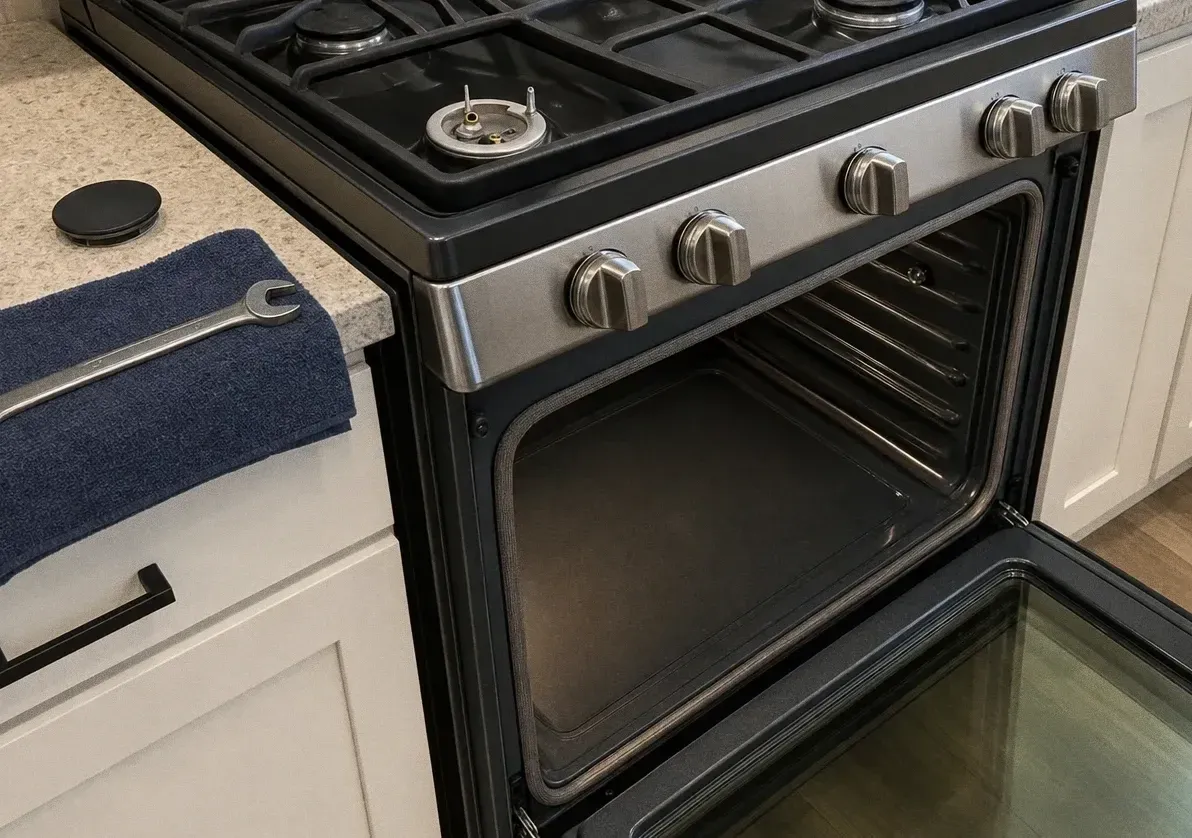
In Massachusetts, a gas range has to be connected by a licensed plumber or gas fitter, and the job normally goes through a gas permit and an inspection from the local gas inspector. Anyone handy can uncrate the range, measure the opening and help slide it into place, but the run from the shut-off valve to the appliance is licensed work. A dual-fuel model adds a licensed electrician for the 240-volt oven circuit. On a 36- or 48-inch Viking, the installs that go smoothly usually split the work three ways: the fitter makes the gas connection, the electrician handles any new wiring, and someone who knows the range checks every burner and the oven before the crate leaves the driveway.
That division matters in Newton, where plenty of kitchens sit in houses built generations before pro-style cooking was common. The pipe that fed the old stove was sized for that stove, and a big range can ask more of it than it was ever meant to carry.
Who handles each part of the install
The gas line and connection
The plumber or gas fitter pulls the permit, then checks that the existing pipe can carry the new range’s total burner input over the distance from the meter. If it cannot, a larger line goes in before the range does. They fit a manual shut-off valve you can reach without dragging a heavy range out of its opening, attach an approved flexible connector, and leak-test every joint. Viking pro ranges ship with a pressure regulator that belongs in the supply line, marked with an arrow for the direction of flow and set for either natural gas or propane. The fitter confirms it matches the gas your house actually has.
Power for ignition and the oven
An all-gas range still needs electricity. A grounded 120-volt outlet powers the spark igniters, the oven light and the convection fan, and it should sit where the range body will not crush the plug. A dual-fuel range needs a dedicated 240-volt circuit sized to the specification sheet for that model, which is a job for a licensed electrician under a permit of its own.
Setting, leveling and the anti-tip device
The delivery crew or installer moves the range in without dragging it across the floor, fastens the anti-tip bracket, and levels the range on its adjustable legs so the cooking surface meets the counter. The backguard, whether a low trim, a high shelf or an island trim, goes on at this stage.
Measure before the range is delivered
Most fit problems show up on a tape measure weeks ahead. Check these with the range’s installation guide open, because the exact figures change from model to model:
- Width. The opening has to match the range’s nominal width, such as 30, 36 or 48 inches, with no cabinet face, trim piece or tile edge intruding.
- Depth. Pro-style ranges are deeper than standard base cabinets and stand slightly proud of them. Make sure nearby drawers and a dishwasher door beside the range can still open fully.
- Height. The legs adjust, but only through a limited span. A new floor or a thick stone counter can push the opening outside it.
- The path in. Measure doorways, hall corners and any stairs. These ranges are heavy, so plan floor protection and enough people to carry rather than slide.
- Overhead and sides. The guide lists a minimum clearance from the cooking surface to combustible cabinets above and to tall cabinets beside it. Island installs need island trim and their own rear clearance.
- Ventilation. Pro burners put out a lot of heat. A properly sized hood is part of the plan, and a large hood can bring a makeup-air requirement under the building code, so settle that before the cabinets are built.
Install mistakes that bring a technician back
Most calls in the first weeks after an install trace back to the hookup, not to a defective range.
Regulator trouble. A missing regulator, one fitted backwards, or one set for the wrong gas produces flames that are lazy and yellow, or too small to bring a pot to a boil in reasonable time. A propane conversion done halfway, with some orifices changed and others not, shows up as burners that behave differently from one another.
An undersized supply line. The tell is a range that seems fine with one burner lit, then sags across the whole top once the oven and several burners run together.
A kinked connector or pinched cord. Pushing a heavy range back into its opening can fold the flexible gas connector or trap the power cord against the wall. Either can starve the range of gas or cut power to the ignition.
A range that is not level. Oil runs to one side of the pan, the oven door may not close square, and cakes come out lopsided.
Burner caps and grates out of place. Shipping and unpacking knock caps off their seats. A cap that sits slightly off gives an uneven flame ring and can keep an igniter clicking. If every burner clicks at once and will not stop, our guide to Viking burners that all click together walks through the usual causes.
Packaging left inside. Racks wrapped in plastic, foam blocks and tape in the oven cavity smoke and smell on the first preheat, and can mark the finish.
When something is wrong after installation
A smell of gas means stop: light nothing, get everyone outdoors, and only then phone your gas company or emergency services. Leaks, pressure problems and regulator questions go back to the fitter who did the hookup, because that work sits under their permit.
Once the gas supply checks out, the remaining faults belong to the range itself: an igniter that fails, a burner that will not hold a simmer, or an oven that will not reach temperature. That is where we come in. Viking Repair Newton is an independent shop that works on Viking ranges in West Newton, Auburndale, Newton Highlands and Newton Centre, using factory-approved parts. A visit is a flat $95 for the diagnosis, and that amount comes off the bill if you go ahead with the repair. Replacing a damaged igniter or burner assembly typically runs $290–$610, and you get the firm price once the fault is found. You can read more about our Viking range repair work, or call (508) 785-6498 to book a visit.
Still asked on the phone
Can I install a gas range myself in Massachusetts?
Not the gas connection. Massachusetts limits gas fitting to licensed plumbers and gas fitters, and the work normally needs a permit and an inspection. You can still unpack the range, measure the opening and help set it in place, but the hookup from the shut-off valve to the appliance belongs to the licensed trade.
Does the delivery company's installer count as a gas fitter?
Only if the person making the hookup holds a Massachusetts plumber or gas fitter license. Some delivery services send a licensed installer and some only set the appliance in place, so ask before delivery day who will connect the gas and who will pull the permit.
Does a dual-fuel Viking range need an electrician?
Yes, in most kitchens. The electric oven in a dual-fuel range needs a dedicated 240-volt circuit sized to that model's specification sheet, and a new circuit is work for a licensed electrician. An all-gas range only needs a grounded 120-volt outlet for the igniters, the oven light and the convection fan.
Why are the flames on my newly installed range yellow or weak?
Usually the gas supply is the cause, not the range. A missing or backwards regulator, a regulator set for the wrong gas, or a supply pipe too small for the new burners will all give lazy or weak flames. Have the installer recheck pressure and the regulator first; if both are right, the burners and orifices need a look.
What does it cost if a technician has to come out after the install?
The visit is $95, which pays for the diagnosis and is taken off the repair bill if you approve the work. If an igniter or burner assembly turns out to be damaged, that repair typically lands in the $290–$610 range, with a firm price given once the fault is found.